
AI projects often look successful early on. Strong demos impress stakeholders. Prototypes function beautifully in controlled environments. This creates a false sense of confidence that can backfire later. The gap between demo conditions and production reality stays invisible until it’s too late. Early success misleads because it hides the structural weaknesses that only appear under real load.
Real problems surface later when nobody expects them. Integration chokes on undocumented legacy systems. Scaling costs spike sharply with actual users. Features that worked in the lab fall apart under real usage patterns. This article focuses on companies structured to handle AI after launch. They keep it alive when conditions get messy, not just build it for a slide deck.
Top 5 Companies That Keep AI Running After Launch
This list is built around what happens after release, not before it. Early-stage metrics don’t matter much once systems go live. What matters is how they behave under real load, how they connect to existing infrastructure, and how they evolve over time. The companies below were chosen for their ability to deal with that stage. Each one solves a different part of the problem that starts when AI stops being a prototype and becomes part of an actual product.
1. Geniusee
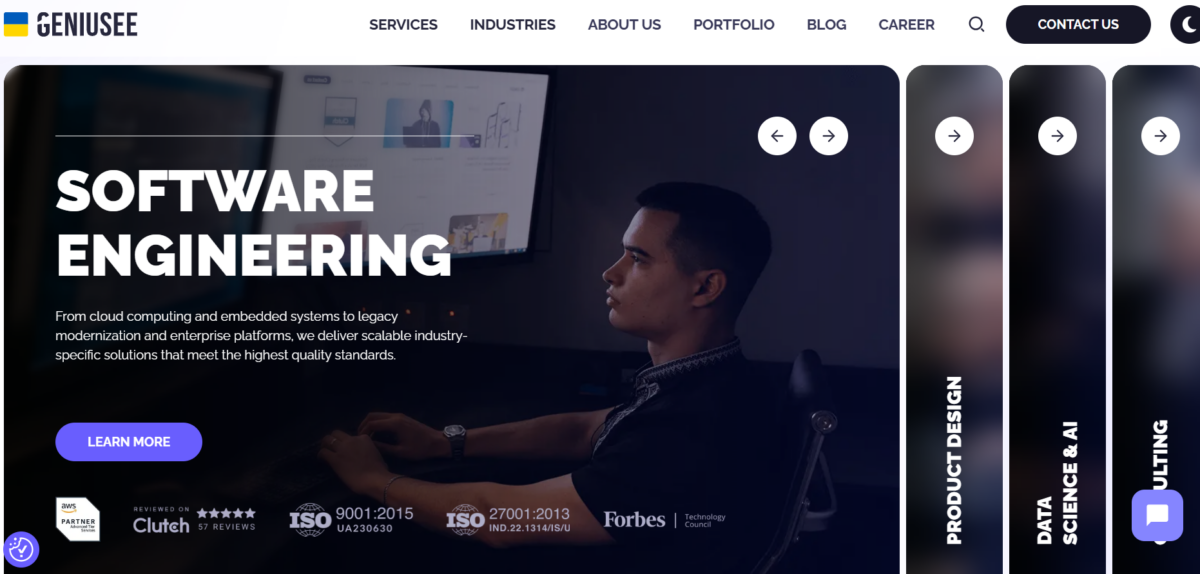
Geniusee operates where AI meets everything else: web platforms, mobile apps, custom software stacks, cloud infrastructure, QA processes. This breadth matters. Most AI failures trace back to integration problems rather than model deficiencies. An AI component works perfectly in isolation until it must communicate with a legacy database nobody fully understands. Then it needs to squeeze into an existing user flow designed years ago. Or survive a DevOps pipeline built for traditional software releases. Geniusee is built around this reality and covers the full engineering scope needed to keep things working.
Capabilities That Keep AI Running After Launch
AI systems do not stay healthy on their own after deployment. Usage patterns shift in unpredictable ways over time. Requirements evolve once stakeholders understand what the system actually does in practice. Infrastructure needs monitoring and cost controls drift without constant attention. Model outputs require ongoing validation against shifting business expectations. A launch-day snapshot of performance means nothing six months later.
Geniusee covers the full lifecycle and underlying infrastructure that makes long-term AI operation viable. Their approach connects model behavior to the broader systems surrounding it. Specific capabilities include:
- Generative AI integration inside existing products;
- Full coverage across web, mobile, custom software, QA, and DevOps;
- Support for NLP, computer vision, and enterprise AI use cases;
- Ongoing maintenance and iteration after launch.
This combination of AI capability and full-stack engineering support ensures systems remain stable and adaptable over extended timeframes.
2. Toptal
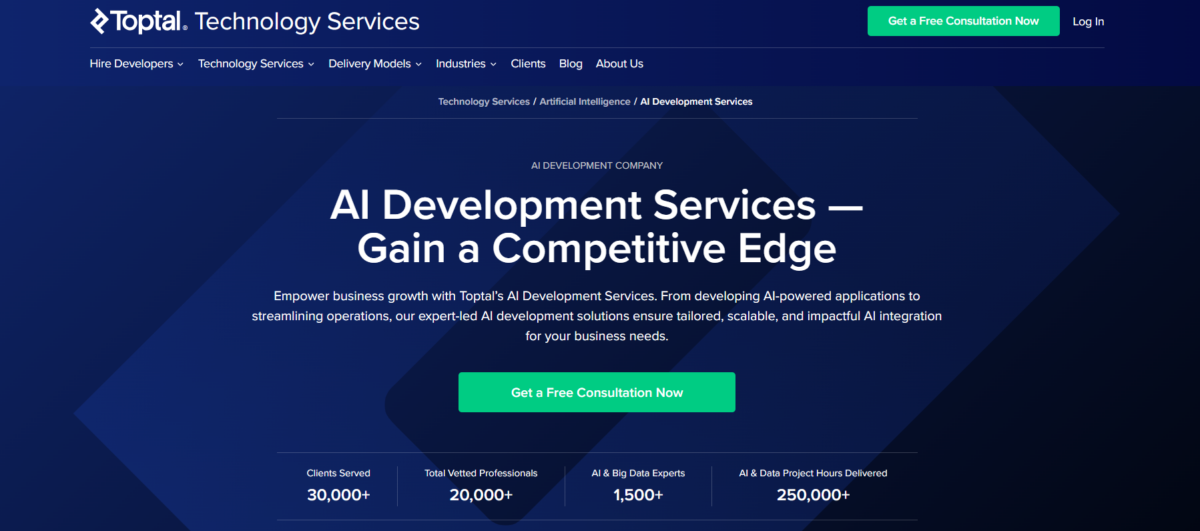
Toptal functions as a flexible talent network rather than a traditional fixed-team consultancy. Their model connects companies with vetted AI engineers and specialists who integrate directly into existing teams. This flexibility matters because AI project requirements rarely stay static for long. What begins as focused model fine-tuning might quickly expand into infrastructure scaling work. The ability to adjust team composition without lengthy hiring cycles becomes a structural advantage when direction shifts unexpectedly.
Where Flexibility Becomes Critical
Many AI projects fail because requirements change faster than team structures can possibly adapt. The initial plan calls for one specific skillset. Three months later, you need something else entirely. Traditional consulting arrangements lock clients into fixed resources that may no longer match the actual work required.
Flexibility in team composition and scaling becomes a survival mechanism when project direction remains fluid. Toptal’s approach addresses this operational reality directly through:
- Access to vetted AI engineers and specialists;
- Flexible scaling based on project needs;
- Fast integration into existing teams;
- Strong fit for evolving AI projects.
Toptal works best when requirements have not fully crystallized and the path forward requires adaptation rather than rigid execution.
3. Thoughtworks
Thoughtworks brings an engineering-driven philosophy to AI implementation with heavy emphasis on system architecture. Their reputation rests on building software that does not collapse under its own weight as complexity grows. This architectural focus translates directly to AI work. Early design decisions often lead to problems later. A model stitched together with brittle integrations might survive launch week but will not survive the first major system update.
Where Architecture Defines Outcomes
Weak architecture kills AI systems slowly and quietly over time. You might not even notice for months. Then something changes: a dependency updates or usage patterns shift. Suddenly the AI component that worked fine starts producing garbage outputs or burning compute budgets at alarming rates. The problem is rarely the model itself. It is the scaffolding around it.
Thoughtworks structures engagements around architectural soundness and maintainability rather than just feature delivery speed. Their strengths cluster around system-level thinking which includes:
- Strong system architecture and design focus;
- Integration into large-scale platforms;
- Emphasis on maintainability;
- Deep engineering practices.
This approach prevents the kind of long-term breakdowns that emerge when AI gets treated as isolated components instead of parts of a living ecosystem.
4. Slalom
Slalom positions itself as a business-oriented AI partner focusing on implementation within actual operational workflows. Their consultants work where AI capabilities meet daily business processes. This matters enormously. AI fails most predictably when it does not align with how people actually work. A brilliant model that requires users to completely change their behavior will get abandoned quickly. A simpler model that fits existing workflows survives and thrives.
Where AI Meets Business Operations
AI that ignores operational reality becomes expensive shelfware, collecting digital dust. Teams build impressive systems that nobody ultimately uses. The disconnect usually traces back to misalignment between what the AI does and what the business actually needs to accomplish. Integration with workflows matters more than model sophistication for sustained user adoption.
Slalom’s approach prioritizes business alignment and measurable outcomes over technical novelty in isolation. Their implementation focus addresses human and operational dimensions through:
- Strong focus on business integration;
- Cloud and AI implementation;
- Alignment with operational workflows;
- Focus on measurable outcomes.
Companies needing AI that actually gets adopted by real users in real contexts will find this approach more durable than pure technical sophistication.
5. Cognizant
Cognizant operates as a large-scale enterprise partner handling complex AI systems at significant volume. Their practice spans automation, governance frameworks, and integration into sprawling corporate ecosystems. Enterprise AI introduces constraints that smaller implementations never face. Compliance requirements dictate what data can move and where. Cost governance becomes a board-level concern when compute bills hit seven figures annually.
Where Scale and Governance Matter
Large-scale AI systems generate challenges that prototypes and mid-market deployments simply do not encounter. Governance stops being a checkbox exercise and becomes central to operational survival. Cost control requires active management rather than periodic cursory review. Compliance demands documentation that smaller teams would find excessive, but regulated industries require as table stakes.
Cognizant structures engagements around these enterprise realities rather than treating them as afterthoughts. Their strengths align with the complexities of operating AI at scale:
- Enterprise AI and automation;
- Governance and compliance focus;
- Integration into large ecosystems;
- Support for complex transformation.
Cognizant fits organizations where AI operates inside heavily regulated environments, where scale creates additional challenges.
Where AI Projects Actually Break
AI systems degrade over time rather than failing instantly with clear error messages. The degradation happens slowly and almost imperceptibly at first. Outputs drift slightly from expected baselines. Latency creeps upward millisecond by millisecond. Costs accumulate faster than forecasted models predicted. Nobody notices because the changes seem subtle until the system no longer works right.
This pattern repeats across industries because underlying causes remain remarkably consistent. Teams build for demos, but production reality hits differently. The most common failure points emerge from these structural weaknesses:
- Weak integration with existing systems;
- Poor control over outputs and costs;
- Demo-ready but not production-ready features;
- Lack of iteration support;
- Gap between prototype and production.
These patterns surface everywhere from startups to Fortune 500 firms. The specifics vary but structural causes do not.
What To Compare Before Choosing an AI Partner
Evaluating an AI partner requires looking past polished demos and slick pitch decks. Demos show you what the partner wants you to see under optimal conditions. Production readiness reveals itself through different signals entirely. How they handle integration questions matters most. What their handoff documentation looks like indicates future pain levels. If they ask about your current setup before proposing anything, that’s a good sign.
The criteria that actually predict long-term success cluster around operational discipline rather than AI buzzwords. Before signing anything examine these dimensions closely:
- Production readiness;
- Integration capability;
- Ability to support iteration;
- Governance and cost control;
- Long-term support.
These factors determine whether your AI investment delivers sustained value or becomes another expensive lesson in the gap between demos and reality.
Final Thoughts
AI success shows up months after launch, not during demo day. Stable performance under changing conditions is what actually matters. Predictable costs and clean integration across updates are signs that everything was built with real usage in mind.
These outcomes matter more than benchmarks or case studies. Some teams can build features, others know how to keep them running. The difference becomes obvious over time, especially when things stop going according to plan.